Corner Shelves vs Storage Carts: Keep Apartment Walkways Clear

Corner storage walkway clearance

Small-Space Storage

Neither corner shelves nor storage carts have to block your small apartment walkways, as long as you pick the right option for your corner’s depth and measure correctly before you shop. If you skip pre-shopping measurements or pick the wrong storage type for your space, even compact corner storage can stick into foot traffic paths and violate this year residential egress rules that require 36 inches of completely clear walkway width at all times. This piece walks you through the exact, no-fancy-tools steps to measure your unused apartment corners correctly, breaks down clearance rules for households with and without mobility aid users, and compares blockage risks of fixed shelves vs. rolling carts so you avoid buying storage that juts into high-traffic paths. Choosing safe, functional corner storage for your apartment comes down to matching the unit size to your nook dimensions and leaving full clear egress width for walking and emergency exits. Most small apartments work best with either no-drill floating corner shelves or slim wedge-shaped rolling carts, depending on how deep your unused corner is. This guide covers exact measurement processes, fire safety egress requirements, product comparisons, and renter-friendly installation ideas to help you pick storage that maximizes space without creating tripping or exit hazards.

Fire Safety and Accessibility Guidelines

Egress Path Width Requirements

Standard Residential Minimums

All residential walkways leading to exterior exits need 36 inches of completely unobstructed clear width at all times. That measurement counts from the furthest protruding edge of any furniture or storage to the opposite wall or nearest fixed obstacle. Most shoppers only measure the empty corner slot before picking a shelf or cart, and forget to subtract the space their new storage will take up from the existing walkway width. That oversight is the top reason perfectly sized corner storage ends up blocking egress paths.

Accessible Path Requirements for Mobility Aid Users

If you or anyone in your household uses a walker, wheelchair, or cane, that clear minimum widens to 44 inches for straight paths, and 60 inches for corners where turns are required. Fixed corner shelves take up permanent space, so you will need to size them to leave that full clear width available 24/7. Rolling carts work well here if you prioritize maximum storage capacity: you can push them fully into the corner when not in use to preserve clear path width, and pull them out only when you need access to stored items. Skip any cart with stiff, sticky locking mechanisms that take extra time to disengage, as they can slow emergency path clearing if needed.

Common Storage Placement Hazards

Never tuck storage units directly next to entry or exit doors, even if they fit perfectly in the adjacent corner. Even a 6-inch protrusion next to a door frame can slow exit during an emergency, or catch on bags, coats, or mobility aids as people move through. If you use a rolling cart, avoid stacking loose, lightweight items on its top shelf that can fall and block the path if the cart is jostled during a rush to exit. Don’t store heavy or sharp items on the lowest shelves of corner units near walkways, where they can spill into the egress path if knocked.

Inadequate Pre-Installation Space Planning

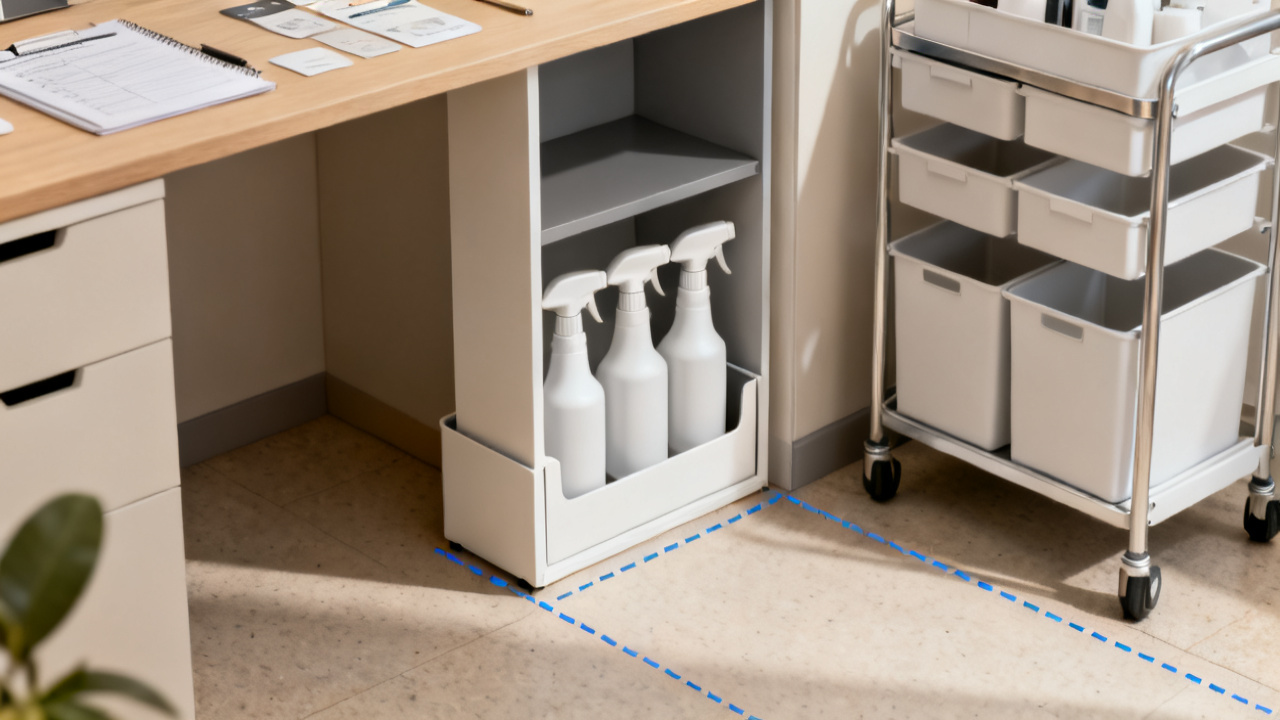
Most people only measure the two flat walls of a corner to pick storage size, and skip accounting for both the corner’s actual usable depth and the required clear egress space in front of it. I’ve found the simplest way to get an accurate measurement is to cut a 6-inch square piece of cardboard, tuck it snugly into the corner, then use a binder clip to attach your tape measure to the edge of the cardboard facing out into the room. That gives you a precise baseline for how far your storage can protrude without cutting into your required egress width. If you’re choosing a fixed shelf, mark that maximum protrusion line on the floor with painter’s tape before you install anything, to confirm the unit won’t extend past it. If you’re choosing a cart, test pushing it fully into the corner to make sure it sits behind that line when not in use.

Unused Apartment Corner Measurement Processes

Required Tools

Beginner Basic Tools

You don’t need fancy equipment to get accurate measurements for corner storage. Start with a standard retractable tape measure, a 4×4 inch square piece of cardboard, and a single binder clip. The cardboard and clip are a low-effort hack to mark consistent reference points even if your corner isn’t perfectly square, no specialty skills needed.

Optional Precision Tools

If you’re ordering custom floating shelves or fitting a cart that needs to sit fully flush to the walls, a digital angle finder can speed up the process. You don’t need to buy one for a basic install, though – the basic tool kit will work for 90% of small apartment corner storage projects.

Step-by-Step Measurement Guides

Standard Measurement Workflow

First, move all clutter out of the corner and 3 feet out into the adjacent walkway so you don’t take measurements around temporary obstructions. Use the square cardboard to mark a reference point 1/4 inch out from each wall where they meet at the corner; this gap accounts for baseboards, uneven drywall, or caulk lines that would make a flush fit impossible otherwise. Next, measure the width along each wall from your reference mark to the nearest permanent obstacle – that could be a door frame, outlet, light switch, or the edge of your required clear walkway space. Then measure height from the floor to the lowest overhead obstruction, like a window sill, wall art hook, or ceiling trim. Finally, stretch your tape measure between the two reference marks on the adjacent walls to get the diagonal span of the corner opening.

Key Dimensions to Track

Jot these four numbers down before you shop for any corner storage:

  • Width along each adjacent wall from your 1/4 inch reference marks
  • Clear height from the floor to the lowest overhead obstruction
  • Diagonal span across the corner opening
  • Distance from the deepest point of the corner to the edge of your clear walkway

Common Measurement Mistakes to Avoid

I’ve found the most frequent error is measuring right against the corner seam without leaving that 1/4 inch gap for baseboards and uneven walls. If you skip that step, your shelf or cart will sit further out into the room than you planned, and may end up blocking the walkway. Another easy slip is skipping the diagonal measurement. A corner might look like it has enough width along each wall, but the diagonal span tells you how far out any storage can extend before it sticks past the wall line. If you’re considering a rolling cart, don’t forget to measure the path from your front door to the corner too. Even if the cart fits the corner perfectly, it won’t do you any good if you can’t get it down your hallway in the first place.

Corner Shelves vs Storage Carts Comparison

Core Pros and Cons

Corner Shelves

They use zero floor space, which is a huge win for 500 sq ft or smaller apartments. Most styles mount directly to wall studs or use adhesive strips for no-drill installation. You can pick floating designs that blend with your existing decor for almost no visual clutter. The main downside is they’re fixed in place; you can’t rearrange them on a whim if you change your layout. Basic floating models also aren’t built to hold heavy items like full power tool sets.

Storage Carts

Carts are fully mobile, so you can pull them out when you need access to supplies and tuck them away when you don’t. I’ve used a slim rolling cart in a weird 14-inch bathroom corner for over a year, and it fits perfectly where no pre-made shelf would work. The biggest con is that if you leave them pulled out or place them in a corner that’s too shallow, they stick directly into high-traffic walkways. They also take up a small amount of floor space even when tucked in.

Weight Capacity Specifications

Corner Shelves

Basic adhesive-backed floating corner shelves hold light loads, enough for spice jars, small mugs, or decor. Steel-framed corner shelves mounted to studs can hold far more, but these usually have a small base that touches the floor, so they don’t count as fully zero-footprint. Never stack heavy items like cast iron cookware on basic floating shelves; the load path fails long before the wood or plastic cracks, even if the material feels thick.

Durability Differences

Aluminum carts resist corrosion better than plastic or steel models, making them the better pick for damp bathrooms or laundry nooks. For corner shelves, durability depends far more on how you mount them than the raw material thickness. A properly mounted ½-inch thick pine floating shelf will last longer than a 2-inch thick oak shelf mounted only to drywall anchors.

Suitability for Renters vs Homeowners

Carts are the most renter-friendly option, no installation required, no holes to patch when you move. If you’re a renter who wants corner shelves, stick to adhesive-backed models that peel off without damaging paint. Homeowners can drill heavy-duty, stud-mounted corner shelves for permanent, high-capacity storage that won’t shift over time.

Ideal Use Cases by Room

In kitchens, use corner shelves for frequently reached spices and mug collections, so you don’t have to dig through lower cabinets. Use a cart for extra pantry snacks or cleaning supplies you pull out for meal prep. In bathrooms, shelves work for toiletries and decor you don’t move often, while carts are perfect for hair tools or cleaning supplies you carry between rooms. In living rooms, shelves hold books and framed photos, while carts work as portable side tables for movie nights or guest gatherings.

Walkway Blockage Risk Comparison

This is where most people make bad choices. Carts only block walkways if you don’t measure your corner first. If your unused corner is at least 12 inches deep, a standard slim rolling cart tucks completely out of the path of foot traffic. If the corner is shallower than 10 inches, a floating corner shelf is your only option that won’t stick out into walkways. Don’t forget to account for height when mounting shelves, too. Mounting a corner shelf lower than 6 feet off the floor in a high-traffic corner means you’ll hit your shoulder on it every time you walk past, which is a less obvious but equally annoying form of blockage.

Renter-Friendly No-Drill Awkward Corner Storage Ideas

Most apartment corners aren’t perfectly square. If you just guess dimensions when buying storage, you’ll almost always end up with a piece that juts out 2-3 inches into your walkway, or wobbles because it can’t sit flush against the wall.

  • Cut a 6-inch square piece of cardboard and tuck it as far into the corner as it will go
  • Hold it in place with a binder clip, then run a tape measure from the edge of the cardboard out along both walls to get the exact usable width of the nook

Adhesive No-Drill Corner Shelves

These stick directly to painted drywall, tile, or laminate without holes, so you won’t risk losing your security deposit. They work best for light loads: mugs, skincare products, paperback books, or small decor. Don’t stack anything heavier than 5 pounds per shelf, or the adhesive will peel away over time. They use zero floor space, so they never block walkways, which is their biggest upside for tight studio or 1-bed layouts. The downside is you can’t move them once you stick them without risking paint damage, so lock in your placement before peeling the adhesive backing.

Freestanding Corner Ladder Shelves

These lean against the two walls of the corner, no drilling required. They take up 6 to 12 inches of floor space at the widest point, so they’re a good fit if your corner is in a low-traffic area, like next to a desk or bed, not right next to your front entry. I’ve used one of these in a 500 sq ft apartment for years, and the slanted design means the lower shelves are narrower, so they don’t stick out as far as regular shelves into walkways. Avoid loading only the top shelves, though, because they can tip if unbalanced.

Slim Rolling Corner Storage Carts

These are triangular or wedge-shaped carts that tuck fully into corners, with wheels so you can pull them out when you need access to items on the back. They take up roughly the same floor space as a small waste bin, so they work great in high-traffic areas like kitchen corners or bathroom nooks. If you tuck the cart fully into the corner when you’re not using it, it won’t block walkways at all. The only tradeoff is they have less vertical storage space than ladder shelves, so they’re better for small, frequently used items like cleaning supplies, snacks, or hair tools.

Freestanding Corner Cube Storage With Closed Bins

These are square, segmented storage units cut to fit corners, with fabric or plastic bins you can slide into the cubes to hide clutter. They take up 12 to 18 inches of floor space, so they’re only a good fit if your corner is in a low-traffic spot, like the edge of a living room or bedroom. The closed bins keep dust off your items, which is great if you store linens or out-of-season clothes there. Just make sure you measure the width of your walkway first: if the unit sticks out more than 6 inches past the edge of the nearest wall, it will become a tripping hazard.

FAQ

Are corner shelves or storage carts a better pick for this year small apartments to avoid blocking walkways?

That depends entirely on your corner depth. For corners shallower than 10 inches, floating shelves are your best bet—they use zero floor space and won’t protrude into walkways if mounted correctly. For corners 12 inches or deeper, a slim wedge-shaped rolling cart tucks fully out of foot traffic paths when not in use, with the added benefit of portable storage.

If I use a mobility aid in my this year apartment, what constraints do I need to follow for corner storage?

First, confirm your walkways meet 2026 residential accessible egress minimums: 44 inches of clear width for straight paths, 60 inches for turning corners. Fixed shelves need to be sized to leave this space permanently clear. Rolling carts are a stronger pick here, since you can push them fully into the corner to preserve path width when not in use.

When should I measure my apartment’s unused corners to pick walkway-safe corner storage in 2026?

Small-Space Storage

Measure right after you move all your large furniture into the space, before you shop for any storage. Clear all temporary clutter from the corner and 3 feet into the adjacent walkway first, so you don’t take measurements around obstructions that won’t be there long-term.

What happens if my corner storage sticks 2 inches into my apartment walkway in 2026?

Even a small 2-inch protrusion goes against standard residential egress safety guidelines requiring 36 inches of fully clear walkway width at all times. It creates a tripping hazard for able-bodied people, can catch on bags or mobility aids, and slows exit speeds if you need to evacuate quickly during an emergency.

About the author

QuickSpace Living is an independent home-organization blog. Our contributors organize their own small homes and rentals and write practical, tested guides on storage, decluttering, and household routines. This is general home-organization guidance, not professional advice.


Who writes this
The QuickSpace Living team maintains a small library of home-organization guides based on real measurements, product tests, and routines we use ourselves. We are not professional organizers or interior designers—just renters and homeowners sharing what works in compact spaces.

Scroll to Top