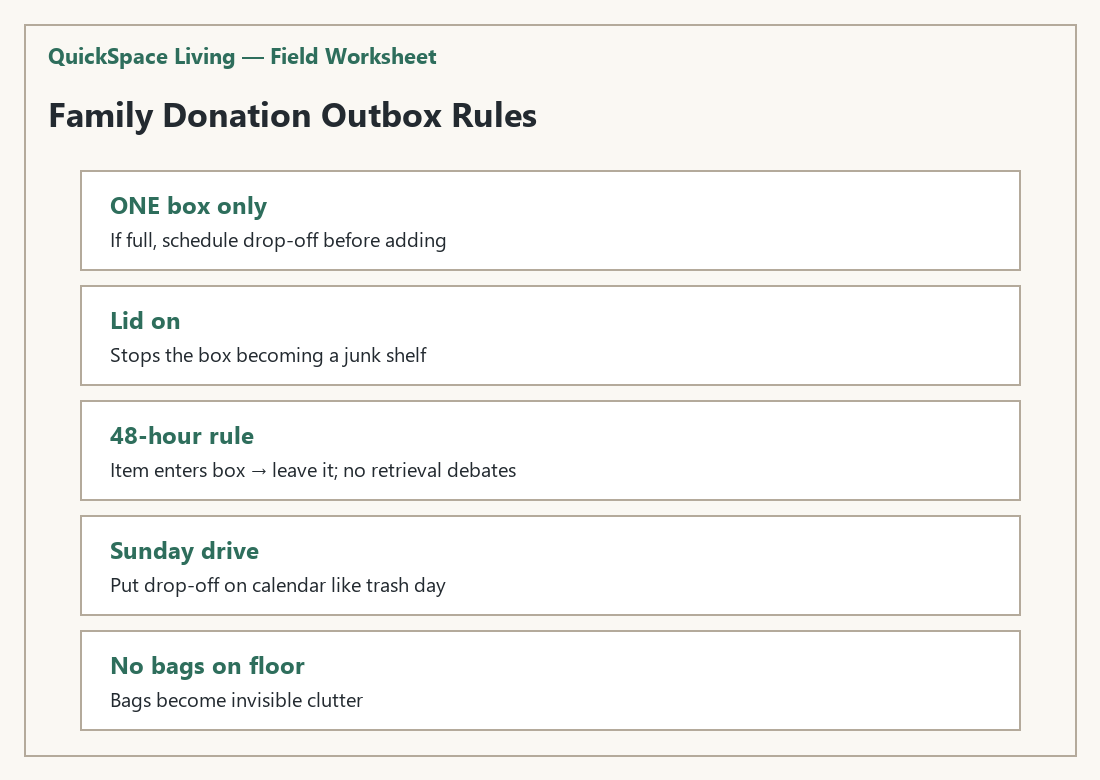
Donation piles die when the box becomes a second closet. Rules have to be boring, short, and tied to a real drop-off day.
Five rules that work for families
- One box only
- Lid stays on
- 48-hour no-retrieval rule after an item goes in
- Sunday drop-off on the calendar like trash day
- No open bags on the floor
Where to put the box
Near the exit you already use for trash or errands—not in a pretty guest room corner you ignore. If the box is invisible, donations stall. If the box is in the nicest room, someone will decorate around it and it becomes furniture.
What goes in (decision shortcuts)
Clothes unworn for a year, duplicates of kitchen tools, kids’ toys with all safety parts present, books you will not reread. What stays out: broken electronics that need e-waste handling, recalled items, and anything damp or moldy. When unsure, use a 10-minute timer and decide; endless sorting is how boxes become archives.
If the box fills mid-week
Schedule a drop-off before adding more. Do not start a second box. A full box is a success signal, not a storage problem.
Tell household members the rules once, then point to the lid. Consistency beats motivational speeches.
How to know the system is working
Give any new setup two full weeks before you buy another product. Track three signals only: can you put things away in under a minute, does the walkway stay clear, and does the surface return to empty at least once a week. If two of those fail, change the rule or the footprint—do not add another bin yet.
When something breaks the system, write one sentence about why. “Shoes overflow because guests leave pairs” is a different fix than “we own too many daily shoes.” Specific notes beat vague frustration and keep this site’s advice useful for your actual apartment.
How to know the system is working
Give any new setup two full weeks before you buy another product. Track three signals only: can you put things away in under a minute, does the walkway stay clear, and does the surface return to empty at least once a week. If two of those fail, change the rule or the footprint—do not add another bin yet.
When something breaks the system, write one sentence about why. “Shoes overflow because guests leave pairs” is a different fix than “we own too many daily shoes.” Specific notes beat vague frustration and keep this site’s advice useful for your actual apartment.
How to know the system is working
Give any new setup two full weeks before you buy another product. Track three signals only: can you put things away in under a minute, does the walkway stay clear, and does the surface return to empty at least once a week. If two of those fail, change the rule or the footprint—do not add another bin yet.
When something breaks the system, write one sentence about why. “Shoes overflow because guests leave pairs” is a different fix than “we own too many daily shoes.” Specific notes beat vague frustration and keep this site’s advice useful for your actual apartment.
Kids and shared decisions
For children’s items, use a weekly “choose three to let go” game instead of surprise disappearances. Items still go into the same one box with the lid on. The ritual matters; the product does not.
Keep a short list of local drop-off places on your phone. Decision friction on Sunday afternoon is why boxes linger. If donation centers are closed, schedule the next open slot the same day rather than returning items to closets.
Quick recap
Measure first, keep walkways clear, maintain on a short weekly timer, and refuse extra products until the current footprint works for two weeks. That sequence is the difference between a real system and a shopping spree that looks organized for one afternoon.
Final check
Walk the room once after setup. If anything crosses a walking line, shorten it or move it. If you feel the urge to buy one more organizer immediately, wait two weeks and reassess with a photo.
Keep it boring on purpose
The systems on this site are intentionally plain: a tape measure, a weekly timer, and a walkway rule. Plain systems survive busy weeks better than decorative setups that need constant restyling. If a step feels optional, keep it anyway for fourteen days before you delete it—most clutter returns when the maintenance step is the first thing cut.
Important note:
This is practical home-organization guidance for everyday apartments and houses. It is educational content, not a product warranty, contractor advice, or a guarantee that every floor plan will fit the same setup.